
Over the past weeks Cauvery and Alia Papageorgiou have been texting and emailing on WhatsApp (principally) and some by email in a #slowinterview with the Irish author on her expansive historical, nature filled novel ‘The Inherittance’ – here are the results for your reading pleasure.
Dear Alia I’m travelling, hosting an event, taking care of someone is how the messages would usually start but here are the results of our Q&A on writing, writing that novel, and how nature spurs us on!
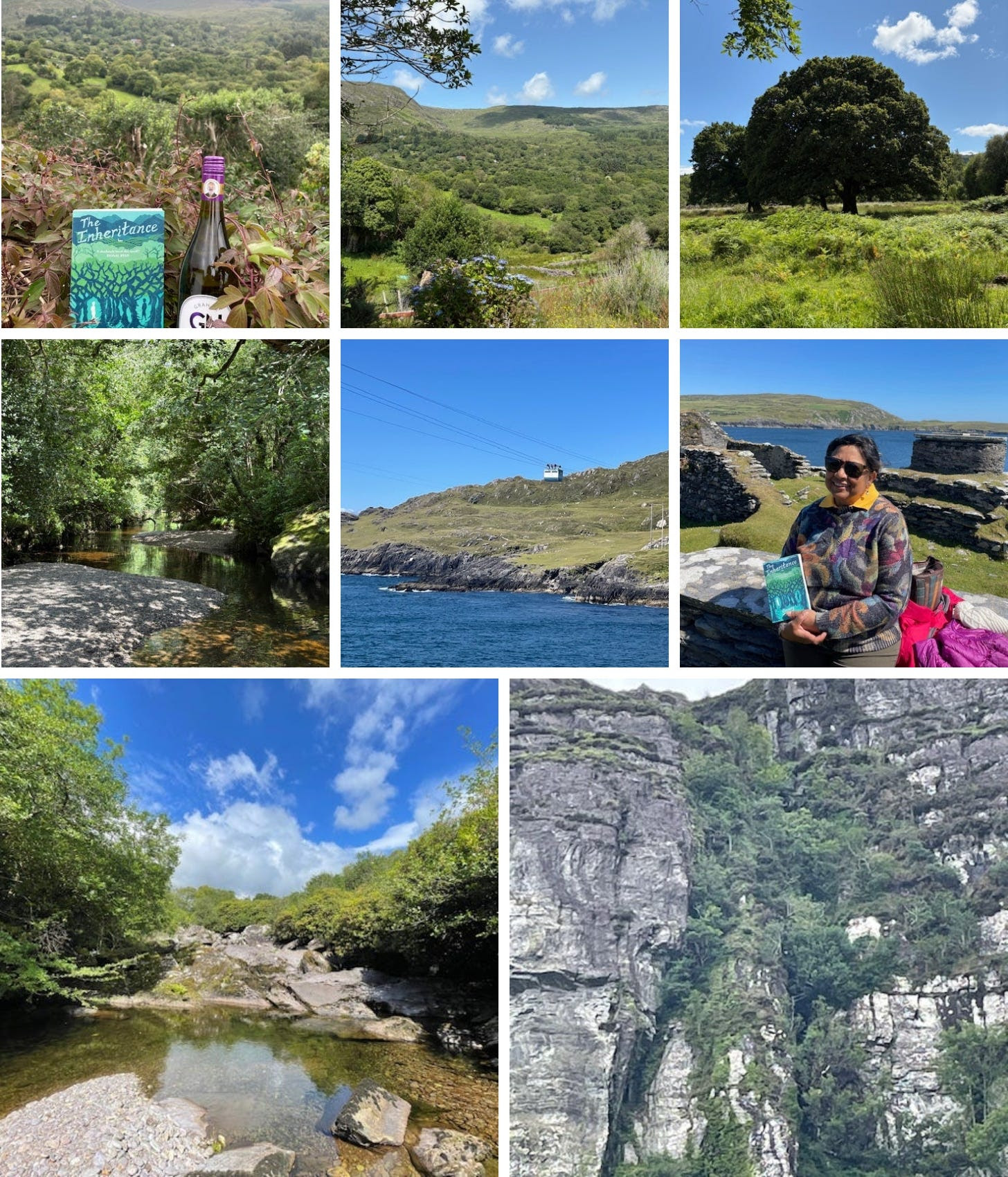
Alia: Going into the Irish country side in West Cork now how does it feel to you? What does it try to share now? I know it felt like such a large part of the book when I read it !
Cauvery: There is something about West Cork that is utterly magical. The landscape is quite untouched and hasn’t been prettified. It’s primeval in places with the geographical features laying bare millions of years of history at a mere glance. You can see how mountains were formed in scrunched up folds and waves and how lakes were gouged out by retreating glaciers. The profusion of pre historic standing stones, burial sites, cairns and stone circles are a testimony to a living landscape.
The communities in the many villages that dot the three peninsulas Mizen, Sheepshead and Beara, are happy contradictions in that they are quite insular and yet very welcoming to visitors on holiday as well as to ‘blow-ins’ who call West Cork home. I think being hospitable and helpful is a particular characteristic of small mountain and costal communities in Ireland.
For me personally, it is a place that captured my heart and soul at first sight. When I drive over the high mountain pass called the Cousane Gap and enter West Cork, my heart always skips a beat and there is an intense feeling of having returned to a place I truly belong.
Alia: What’s inspiring you these days?
Cauvery: Alia, I have started my next book which is set entirely in India. It spans 90 years from around 1930 to about 2010. I do a lot of secondary and lateral research before and while writing – just for me to get a complete picture in of the setting and era in my mind’s eye. And this time it has involved reading a good bit about Mahatma Gandhi‘s life and times. I have had to tear myself away because I find in his teachings, philosophy and way of life a solution for everything that ails us today. There could be no man more relevant for the moment that we find ourselves in!
Alia: How is the book travelling (The Inheritance)? I hear students will be learning from it soon as well such excellent news
😊
Cauvery: The Inheritance is doing really well and I am absolutely delighted that it is on the curriculum in several universities, being taught in English Literature as well as Irish Studies courses.
I was invited to speak at University of Villanova as well Saint Joseph’s University in Philadelphia and had the honour of delivering the annual Gerson Irish Lecture in the University of Connecticut in April of this year. It was an absolute joy to talk to students who have dissected the book over a semester!
I also spoke at many fantastic festivals and university conferences across Europe and India and taking the book to the Jaipur Literary Festival was a huge highlight for me. A lot of my author dreams came true!
Alia: I loved that part of the novel where there is this unseen thread of time connection between the two young boys and they can jump and see each other through the same forest – what brought you to that relationship Cauvery do you think?
Cauvery: Alia, looking back on my writing process with The Inheritance, I find it hard to pick a point where I could say I knew I was going to use magical realism in the story. It kind of evolved organically! I guess it emerged out of my storyline with Sully being a gifted artist and the inspiration for his vivid drawings. I would love to think that there was a bit of magic in the writing process and that I was guided by the spirits of the very people who had perished in the forest in that desperate time in the 1600s. But I guess the reality is that sometimes you can get so wrapped up and moved by details and individual stories unearthed during research that it just demands to be featured and somehow seeps into the book naturally!
Alia: The importance of community , how do you feel that where you live today?
Cauvery: Community is everything. Community is what makes us and what breaks us. I live and breathe that every single day not just as a writer, but as a human being!
I think it’s particularly important when you are a first generation immigrant that you make an effort to belong an and it is a blessing to be part of a community that will invite you to belong.
When we arrived in Ireland, we had absolutely no family to lean back on, it was just the two of us. We depended on our neighbours for even the tiniest of things – whether it was borrowing a bowl of sugar or getting somebody to pick up our child from school when I was at the dentist – these are every day life things that become impossible without a good community of neighbours and friends around you. Over the last 39 years my neighbours have become as good as my family and I just cannot imagine my life without the close sisterhood that I’m part of! They have supported my writing from the start and have both consoled me at every setback and cheered me on with each book.
Alia: also for our writers – how do we finish a book? (Age old question and mystery!) how do you practically do it ? And did you find it an easy or a much difficult process going from columnist to novel author? Any tips welcome
🙏🏽
Cauvery: I really am the worst person to give advice about finishing a book given that I am the world’s biggest procrastinator. But what I have learned from all my procrastinating is that getting into a writing routine is so very important.
Treat it like a 9 to 5 job and arrive at the desk on time! And if you can just overcome the hesitation that sets in when you address the keyboard for the first time in the day, then you can very easily get on a roll. I find sometimes I can get going by editing the last page that I wrote and sometimes I don’t even realise that I have actually started fresh words and have in fact moved on from where I last stopped.
Consistency I think is really important and by that I mean writing every day!
Personally, I need to have a very tidy workspace and if I and if I am in a procrastinating mode that will extend in an extreme fashion from beyond the workspace to the entire house. It is very hard to slap yourself on the wrist and tell yourself that the dishwasher can be emptied later, but you just have to find that steady purpose that comes from treating a writing as a job and not something that is ‘muse-dependent’.
Alia: What surprised you about the writing of the book?
Cauvery: I think this thing that surprised me the most was the ease which I was able to slip into the language of the 1600s. A few early readers commented on it when they were reading the draft and then I myself was struck by it. I think it came from having read so many of the state papers which included reports that were being sent firsthand from Ireland to Queen Elizabeth.
Another thing that struck me was how the tragedies of the 1600s are an absolute mirror image of how women and children are still the primary sufferers in modern war unfolding all around us at this very moment.
Alia: How easy was it to write the bits that was set in the historical past?
Cauvery: I was quite anxious about writing the story of the past, but I think the research I did paid off. Very luckily for me there was so much of detail available online and it meant I could do a lot more reading than I had ever hoped for in order to get the details and the setting in my mind’s eye.
Other than written records, I also looked at paintings, artefacts and items in the museums here in Ireland. It was a very useful way of being able to eyeball the various clothing, jewelry, weapons and arms that were used to fight. I also watched countless movies in order to get a fee for the period. This meant that my research was great fun!
Ends.
All words and photos attributed to the author Cauvery Madhavan, and Alia Papageorgiou from the Writers Festival of Belgium.